Node-RED
Build automations by connecting visual blocks instead of writing code.
Save to collection
Choose a home for Node-RED.
Start your first collection below.
Why it’s worth your time
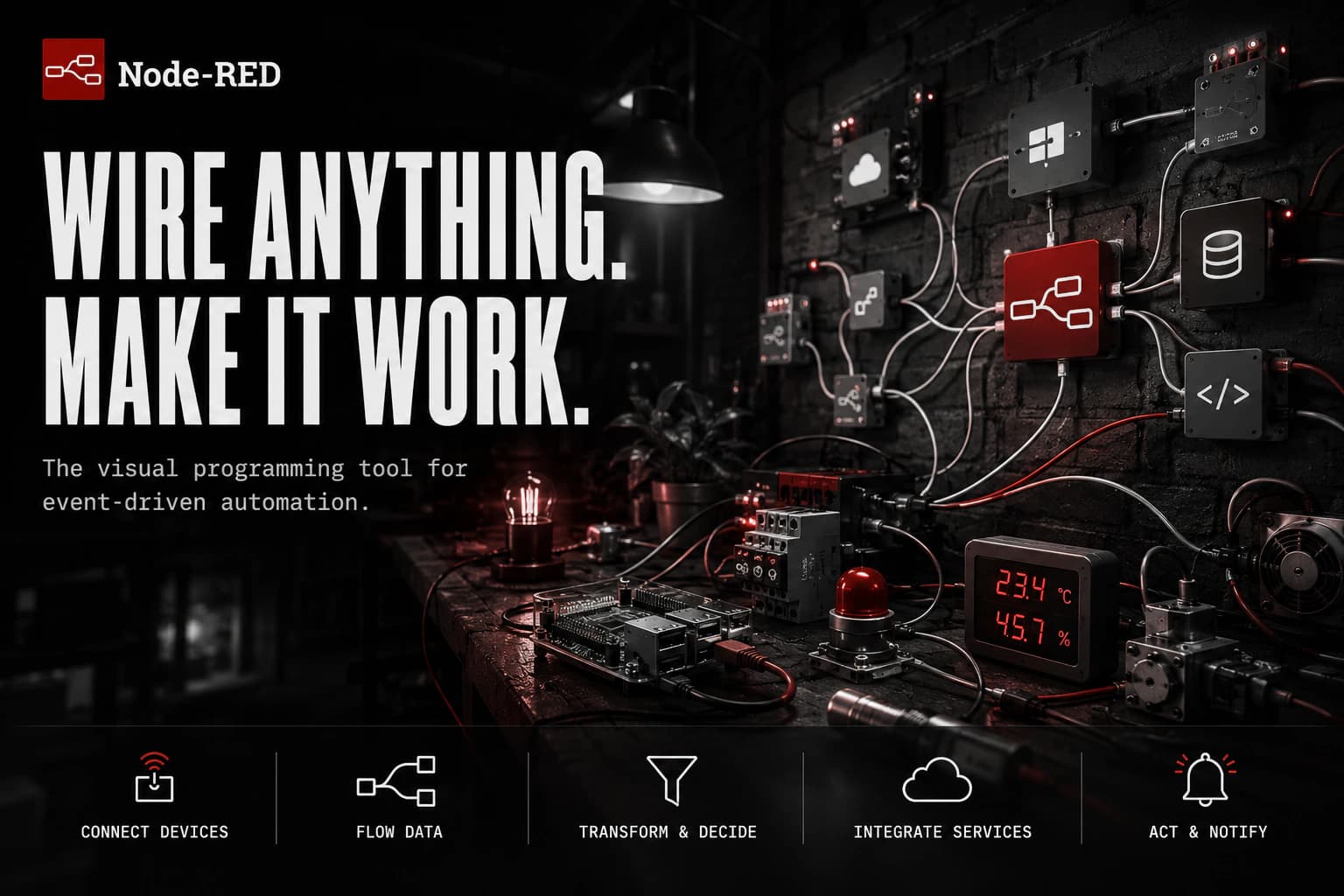
Node-RED is an open-source, flow-based programming environment for connecting devices, APIs, services, databases, and event-driven processes. Programs are assembled by placing nodes on a browser canvas and wiring their inputs and outputs together. A node might wait for a timer, receive an HTTP request, listen to an MQTT topic, transform a message, query a service, or trigger a physical device. Messages move through the visible path, and the debug tools expose their contents, which makes the behavior of an automation easier to inspect than glue code scattered across scripts.
Node-RED grew out of the Internet of Things world, but it now turns up in homes, factories, prototypes, dashboards, and business systems. Thousands of community nodes help obscure sensors and familiar web services speak through the same canvas. The visual editor lowers the entry barrier; it does not repeal data types, state, authentication, or failure. A small flow reads like a diagram of the idea. An undisciplined large one looks like someone dropped a bowl of noodles onto a circuit board. Naming, subflows, and ruthless tidying are not optional once the project grows.
Shared by
Spotted and shared by a Biltib member“I trust systems more when I can watch the data move. In Node-RED, an HTTP request, timer, sensor, or MQTT event becomes a message you can literally follow through the wired nodes, and the debug panel usually tells you where your assumption broke. The community library means a weekend home-automation idea can talk to real hardware before lunch. Big flows do turn into spaghetti, yes, but tidy subflows beat debugging invisible glue code at 2 a.m.”