Biltib field kit 01 · Free download
A worked example and two reusable worksheets for turning saved inspiration into a piece you can make.
Follow Sunday Clay, our fictional ceramics workshop, from a terracotta reference to a clear workshop card. Then use the same process for your own poster, page or small design project.
Free printable PDF · 6 pagesDownload the six-page PDFPrint pages 5–6 for the blank worksheets. No signup.Free editable canvas · ExcalidrawDownload the editable Excalidraw boardFour panels with the worked example, worksheets and an editable workshop card. No signup.Free, with no signup. Print pages 5–6 of the PDF for the blank worksheets. The Excalidraw file includes editable notes, worksheets and a workshop card.
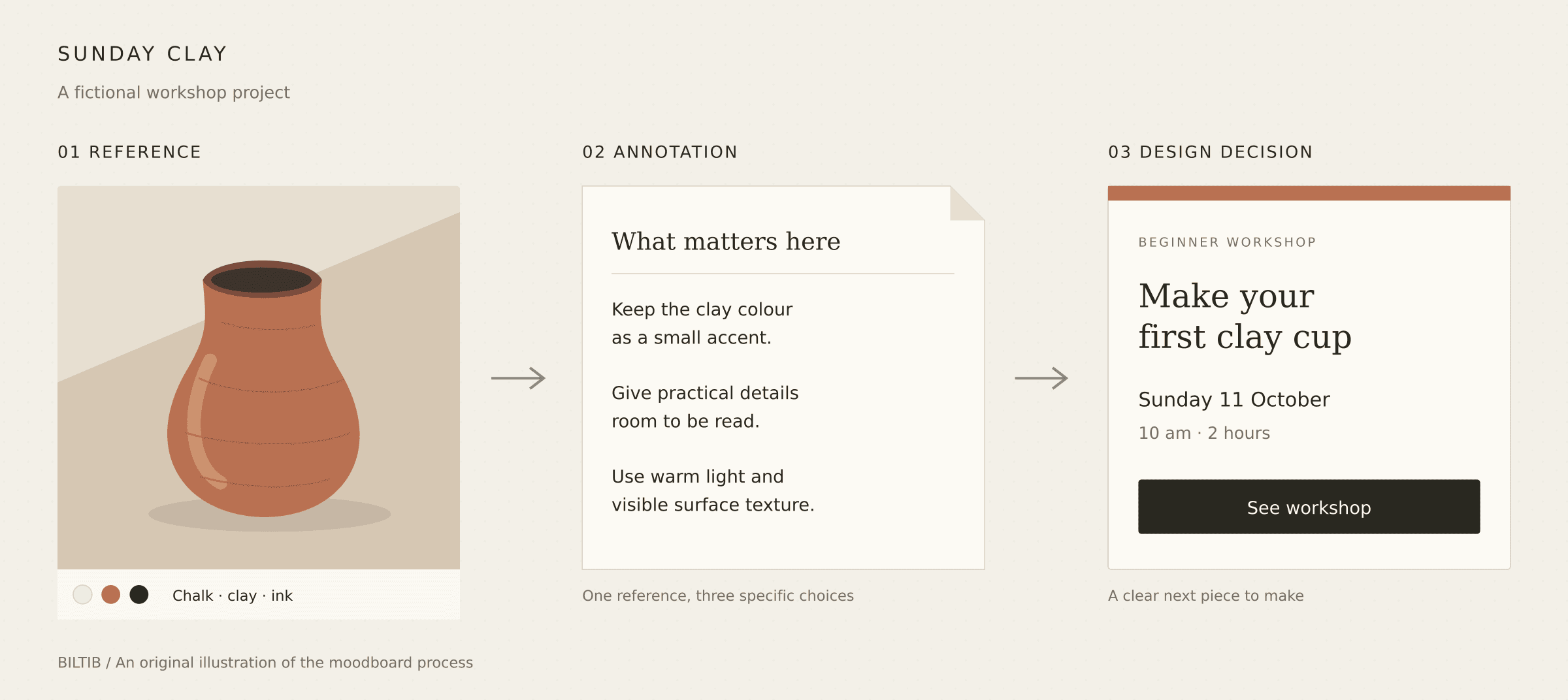
Original Biltib illustration from our moodboard guide. Sunday Clay and its workshop details are fictional.
What is inside
• A short process for choosing one design job
• A worked reference-to-decision record for Sunday Clay
• A finished static workshop card with the choices explained
• Four color roles and five independently calculated contrast pairs
• A blank reference worksheet and a color-and-handoff worksheet
Follow the Sunday Clay example
The brief is to help first-time visitors understand a ceramics workshop and find the next class. The direction is warm, tactile and straightforward. The first piece is one mobile workshop card.
• Reference: the terracotta vessel in our original moodboard illustration. Decision: use clay as a small accent while practical text stays on a plain, light surface.
• Reference: the spacious workshop layout in that illustration. Decision: group the workshop name, date, time and duration, then give the visitor one clear next action.
• Reference: the named roles in our palette guide. Decision: put ink text on chalk, use dark clay for the action, and check its chalk label as a separate pair.
These are original editorial references, not photographs of a real studio. A real launch would still need verified availability, price, location, image permissions and a working destination for the action.
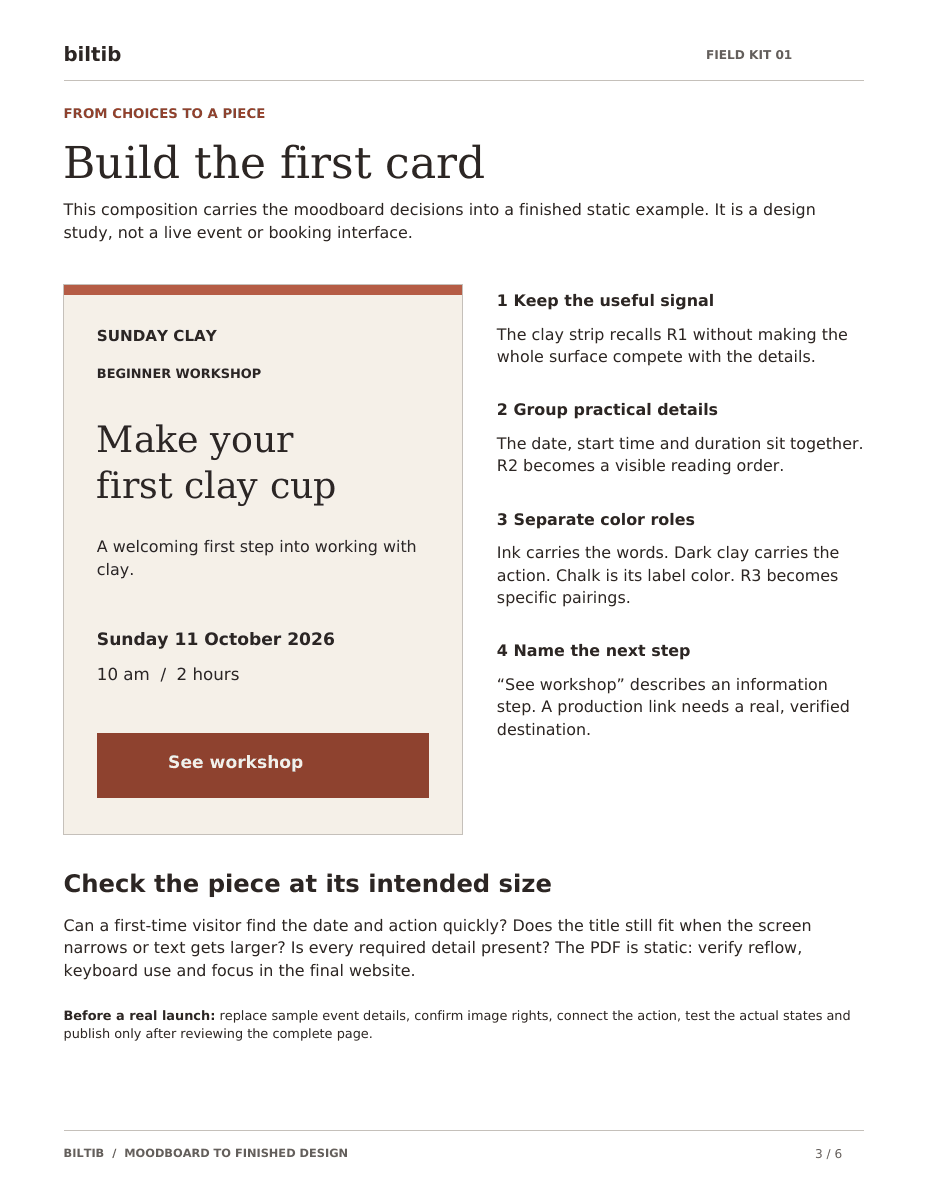
Sunday Clay
Beginner workshop
Make your first clay cup
A welcoming first step into working with clay.
Sunday 11 October 2026 10 am · 2 hours
Sample action label: See workshop
The decisions are visible
The thin clay strip carries the material cue. The date and duration stay together. The action has a specific label and its own checked foreground/background pair.
This is a static design example. The sample action is not a booking link.
Check your own piece at its intended size. Can someone find the practical details quickly? Does the text still fit at a narrow width or when enlarged? Which unresolved question actually needs another reference?
Carry the roles with the colors
Chalk: #F5F0E8 Page surface and button label
Ink: #2B2523 Body text and headings
Dark clay: #8E422F Action background and links
Clay: #B65C45 Decorative accent
Sunday Clay contrast checks
Ink #2B2523 on chalk #F5F0E8 — 13.30:1. Normal-text AA: Pass.
Chalk #F5F0E8 on dark clay #8E422F — 6.23:1. Normal-text AA: Pass.
Dark clay #8E422F on chalk #F5F0E8 — 6.23:1. Normal-text AA: Pass.
Clay #B65C45 on chalk #F5F0E8 — 4.02:1. Normal-text AA: Fail.
Ink #2B2523 on clay #B65C45 — 3.31:1. Normal-text AA: Fail.
WCAG 2.2 AA calls for at least 4.5:1 for normal text, or 3:1 for large text: 18 pt regular or 14 pt bold and larger. Essential control boundaries and meaningful graphics generally need 3:1 against adjacent colors. Do not make color the only way to communicate a state.
Calculated independently on 6 October 2026 from the stated sRGB values using WCAG relative luminance. Display ratios are rounded; pass/fail uses the unrounded value. These checks do not establish accessibility of the whole page. Recheck changed colors, backgrounds, transparency, image overlays and interaction states.
Read the standards: W3C text contrast and W3C non-text contrast.
W3C text contrastW3C non-text contrastUse the blank worksheets
• Name the piece and its audience. Write the action the design needs to help someone take.
• Record three useful references. Keep the creator, original source and rights or permission beside each one. Write the detail you want to learn from and the design choice it supports. Duplicate the worksheet if needed.
• Assign color roles. Record the HEX value and where it is used. Check each real foreground/background pair, including relevant states, and save the ratio, result, checker and date.
• Write a short brief and make one piece. Keep the unresolved question visible. Confirm real content and rights before publishing.
Open the editable file
Download the .excalidraw file, then open Excalidraw. Choose Open in its menu and select the file, or drag the file onto an empty canvas. Double-click text to edit it. Replace the bracketed prompts and add your own or licensed images.
ExcalidrawSave an editable copy to your device after making changes. Browser storage can disappear and is not a substitute for a downloaded copy. You do not need an account to use the free browser editor.
The PDF is a printable reference, not a fillable form. The HTML page provides the worked example as selectable text. The editable board is a visual canvas.
Go deeper when you need to
How to make a moodboard from your saved inspirationTen color palette tools for your next creative projectSunday Clay is a fictional Biltib editorial project. The kit reuses Biltib’s original published moodboard illustration and palette. Keep third-party reference credits with your own work; saving an image or recording its link does not grant permission to republish it.