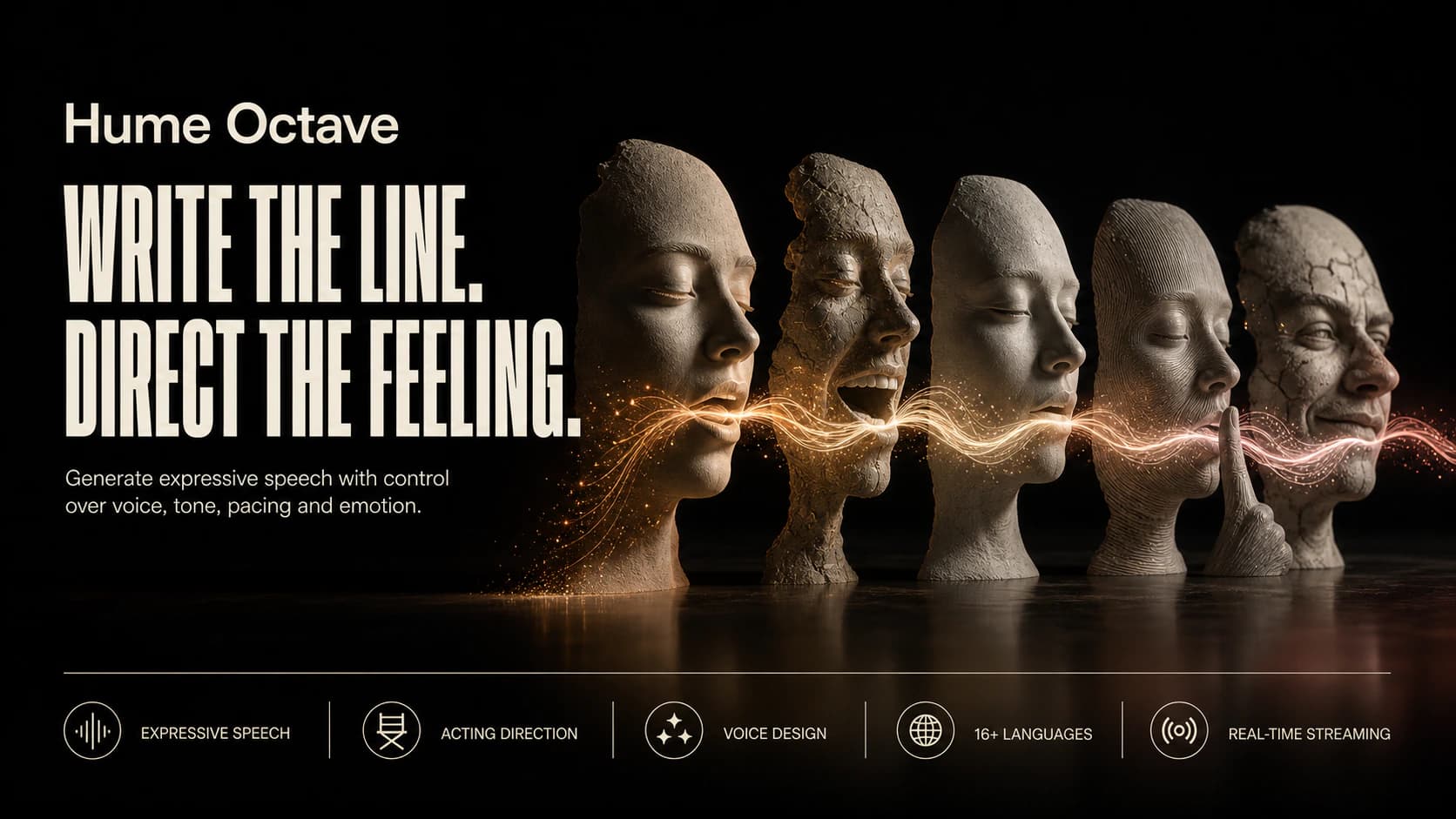
Hume Octave
Direct a voice like a performance, not a speech setting.
Save to collection
Choose a home for Hume Octave.
Start your first collection below.
Why it’s worth your time
Hume Octave is an expressive text-to-speech system built for dialogue, narration, characters, assistants, and other voice work where delivery matters. You can choose a curated voice, clone a voice with permission, or describe a new one in natural language, then direct tone, pacing, emphasis, and emotion through written instructions. The system supports streaming generation, multilingual speech, word and phoneme timestamps, multiple audio formats, speed control, presets, and developer SDKs. Its central object is a performance rather than a neutral reading.
Octave becomes interesting when the question changes from which voice to use to how the sentence should behave. Voice Design lets a creator begin with personality instead of a catalogue name, while written acting notes can shape hesitation, force, mood, and rhythm. Expressive control still requires auditioning. A direction can be interpreted too strongly, a designed voice may need several samples, and a delivery that works for one line can become mannered across a long script. Octave is strongest when generation is treated as casting and directing rather than a one-button promise of a perfect take.
Shared by
Spotted and shared by a Biltib member“Octave does not just read the line; it asks how the line should land. Voice Design lets me start with a character rather than a catalogue, and written acting notes make pacing and intention feel like creative material. The model can overplay a direction and long scripts still require human ears, but this is one of the clearest shifts from speech synthesis toward performance direction.”